
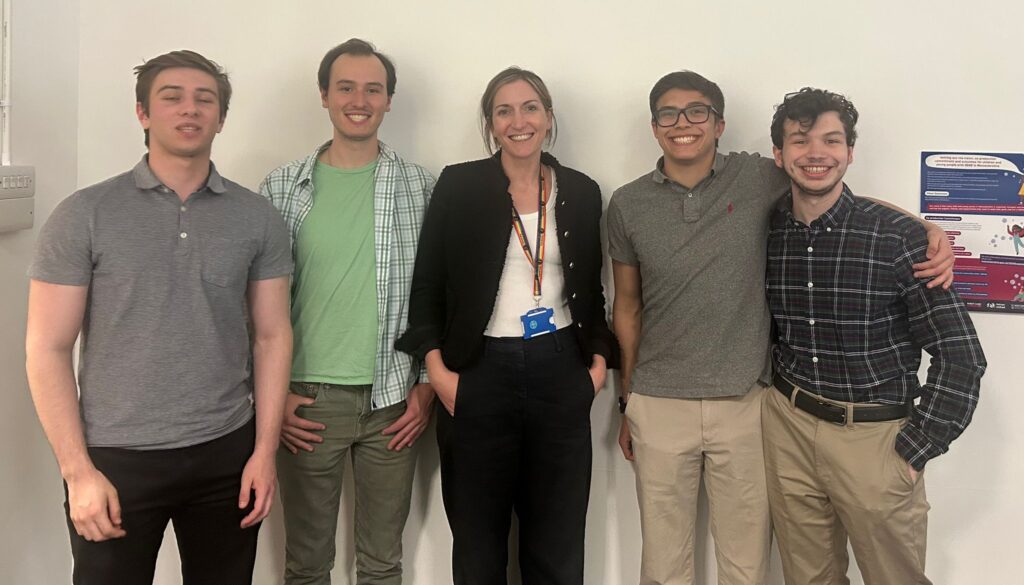
Last week marked the successful conclusion of an inspiring international student collaboration focused on one of the most pressing public health challenges facing the UK: extreme heat events. As part of the University of Worcester’s long‑standing partnership with Worcester Polytechnic Institute (WPI) in the United States, four WPI undergraduate students visited Worcester to complete an Interactive Qualifying Project (IQP) exploring how local communities understand and manage the health impacts of rising temperatures.
Hosted by Dr Jessica Mee (UKRI Future Leaders Fellow) and supported by the Female Heat Lab, the project—Supporting the Worcester Community in Mitigating the Effects of Extreme Heat Events—brought together academic research, community engagement, and applied public health insights. The student team, Gavin Hamburg, Tucker Johnson, Adam Jusczak, and Nicolas Kishchenko, worked closely with the Worcester Community Trust and University of Worcester colleagues to investigate how extreme heat is perceived, experienced, and addressed across the city.
Understanding Heat Risk in Worcester
The project set out to establish a baseline understanding of how Worcester residents perceive both the physical and mental health risks associated with extreme heat. While heatwaves are increasing in frequency and intensity across the UK, public awareness of their impacts—and how to mitigate them—remains uneven.
Using a mixed‑methods approach, the students conducted community surveys, stakeholder interviews, and archival research. Their findings revealed a striking disconnect: while nearly half of surveyed residents initially believed they were unaffected by heatwaves, many later reported disrupted sleep, fatigue, and heat‑related symptoms when prompted with specific examples. Awareness of available community resources was also low, with fewer than 10% of respondents able to identify local heat‑related support.
Crucially, the research highlighted that heat affects people in more ways than they realise, and that much existing guidance—while extensive—is often hard to find or access. These insights formed the basis for a set of practical, evidence‑informed recommendations designed to support community education and resilience.
Practical Recommendations with Community Impact
Working alongside project sponsors, the students developed clear recommendations for Worcester City Council, the University of Worcester, and third‑sector partners. These included:
- Developing clear, accessible information campaigns, including infographics, to increase awareness of heat‑related health risks and mitigation strategies.
- Creating a city‑wide map of cooling centres, making it easier for residents to identify safe, cool spaces during heatwaves.
- Advocating for incentives for landlords and homeowners to improve heat resilience in existing housing stock, particularly given the high proportion of residents living in rented accommodation.
The project outputs demonstrated how student research can translate directly into meaningful community benefit.
Celebrating Student and Staff Collaboration
The project concluded with a showcase event held on Friday 1 May, bringing together project sponsors, University of Worcester colleagues, WPI staff and students, and invited guests for a celebratory afternoon recognising the team’s outstanding work. The event highlighted not only the quality of the students’ research, but also the strength of the partnership between institutions and community organisations.
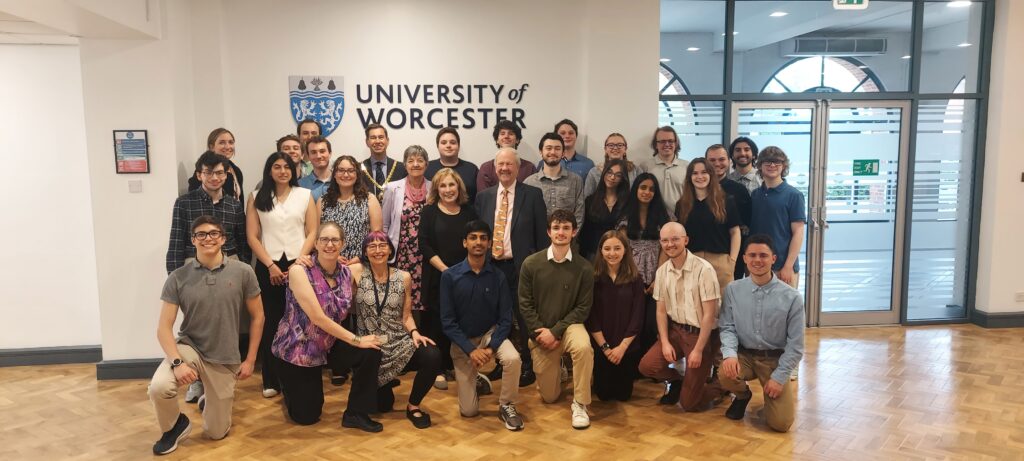
Reflecting on the collaboration, Professor Althea Danielski from WPI shared her appreciation:
“They were really lucky to work with you, and we all learned a lot from the experience. I hope WPI can continue to take advantage of working with such a talented researcher who cares not only for her subject but her students and co‑workers as well.”
Dr Mee also praised the students and the broader partnership, noting the value of working across institutions and disciplines:
“The student team did an excellent job — they were engaged, thoughtful, and a credit to the programme. It was also wonderful to meet Linda and Althea; the students are clearly very well supported by such invested and dedicated academics. I hope I can be involved again in the future.”
Looking Ahead
Projects like this exemplify the University of Worcester’s commitment to impactful, community‑engaged research and international collaboration. As climate‑related challenges continue to shape public health, partnerships between universities, students, and local organisations will be essential in building awareness, resilience, and practical solutions.
The Female Heat Lab looks forward to welcoming future WPI student teams and continuing this important work to support the wellbeing of Worcester’s communities in a warming world.