Written by Dr Jessica Mee
What an incredible few days at ICEE 2026 in Kuching, Malaysia.
The 21st International Conference on Environmental Ergonomics brought together the international environmental ergonomics community for five days of presentations, symposia, posters and plenaries — and, for the first time, ICEE was held in Malaysia.
I was incredibly fortunate to be invited to speak as part of a symposium titled Responses to thermal environments: a focus on females, chaired by Professor Toby Mündel. My presentation, Understanding and Supporting Women in Heatwaves: Awareness, Physiology, and Research Priorities, gave me an opportunity to bring together several strands of our work at the Female Heat Laboratory: what people understand about heatwave risk, what women experience during extreme heat, and where the evidence base still falls short when it comes to supporting women in a warming world.
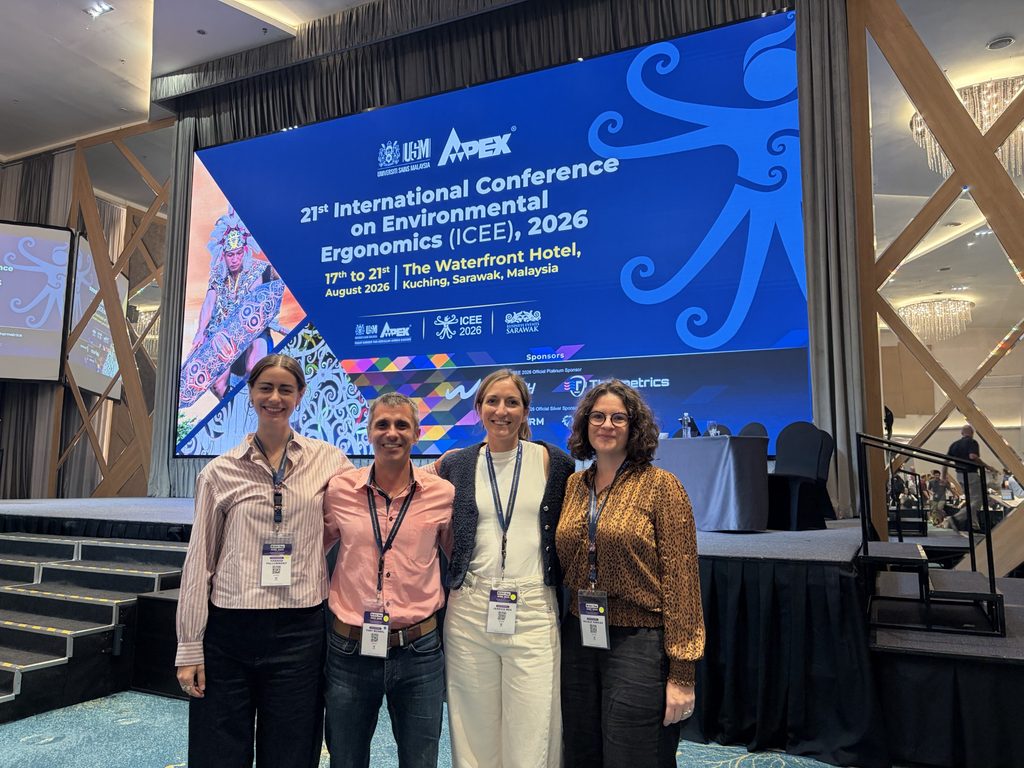
But what made the session particularly exciting was how complementary the three presentations were. We came at the question of women and environmental stress from very different directions, but all landed on the same fundamental issue: we still have a lot to learn about female physiology in environmental extremes.
What we covered
Understanding and supporting women in heatwaves
I opened the symposium by looking beyond the laboratory and asking a slightly different question: what does our current understanding of women’s responses to heat actually mean in the real world?
Our UK-based programme of surveys and focus groups has been exploring public awareness of heatwave risk, occupational experiences during extreme heat, and how well current heat-health guidance reflects the needs of different groups of women.
Pregnancy, menopause, clinical populations and healthy adults all bring different considerations, yet the evidence underpinning current guidance remains surprisingly thin and inconsistent when it comes to female biology.
We know that heat exposure is becoming an increasingly important public health and occupational issue, but knowing that heat is a problem is not the same as knowing how best to protect everyone from it.
I argued that we need research that more rigorously accounts for hormonal status across the female lifespan, alongside practical interventions that women can actually use when adapting to heat — whether that is at work, at home or in the wider community.
And importantly, this isn’t simply about producing more research on women. It is about producing better research.
What do we actually know about sex differences?
Dr Hannah Pallubinsky followed with a fascinating systematic review and meta-analysis examining sex differences in thermal perception and physiology. One of the striking findings was that women reported colder thermal sensations and had lower skin temperatures than men in cool environments, even when core temperatures were similar or higher. Perhaps even more striking was how little evidence exists across female life stages. It was another reminder that when we talk about “women” as a research group, we are talking about an incredibly diverse population — and that diversity has often been missing from the evidence base. If we want to understand female physiology properly, we need to stop treating women as a single, static physiological category.
Heat tolerance isn’t just about physiology
Dr Nicole Vargas then brought a really interesting behavioural perspective to the discussion, presenting emerging research on sex differences in cool-seeking behaviour during heat stress. Women in her work initiated cooling behaviours earlier than men. At first glance, it might be tempting to interpret earlier cooling as evidence that women tolerate heat less well. But that interpretation misses the bigger picture. What if seeking cooling earlier is actually a protective behavioural response? It is a great example of why understanding heat physiology isn’t simply about comparing two numbers and deciding who “tolerates heat better”. Behaviour, perception and physiology interact — and those interactions may be important for how people actually experience and respond to heat. That nuance is exactly what we need more of.
Why this matters beyond the laboratory
One of the things I keep coming back to in our work at the Female Heat Laboratory is that these questions are not just academic. Heatwaves are becoming an increasingly important challenge for public health, workplaces and communities. Yet many of the recommendations we rely on are built on an evidence base that does not adequately represent female physiology. That matters when we are trying to understand how women respond to heat, but it also matters when we are trying to translate that knowledge into practical guidance.
What does a woman working outdoors during a heatwave need to know?
What does a menopausal woman working in a hot workplace need to know?
How should we think about heat risk during pregnancy?
And how confident are we that the research underpinning our recommendations actually reflects the people we are trying to protect?
These are the kinds of questions that sit at the heart of the Female Heat Laboratory.
The bigger question: how do we do better research?
ICEE also reinforced something that has become increasingly important across our work: improving female representation in heat physiology research isn’t just about recruitment. We need to think carefully about study design, ovarian hormone status, menstrual cycle phase, hormonal contraception, menopause and the wider factors that influence how women are represented in research. But we also need to understand what researchers themselves are currently doing — and why.
That is one of the reasons we have launched WHiP – Women in Heat Physiology.
WHiP is exploring researcher practices, perceptions and barriers around the inclusion of women and consideration of ovarian hormone status in heat physiology research using human participants. We want to understand where the field is now, what influences methodological decision-making, and what researchers believe good practice should look like. The first phase is an international survey, followed by interviews and an expert Delphi consensus process. Ultimately, the aim is to work towards evidence-informed recommendations that the heat physiology community can actually use — and, importantly, can get behind.
If you are involved in heat physiology research using human participants, we would love to hear from you.
[Take part in the WHiP survey]
A particularly special moment
One of the most special moments of ICEE was unexpectedly seeing a former undergraduate student of mine presenting her own research. She first came to me as an undergraduate, completing a research project in this area, and it has been incredible to watch where that initial experience has taken her. Since then, she has gone on to complete a successful MSc and is now undertaking her PhD in New Zealand with Dr Jim Cotter. And, as if seeing her there wasn’t special enough, she went on to win first place in the poster competition!
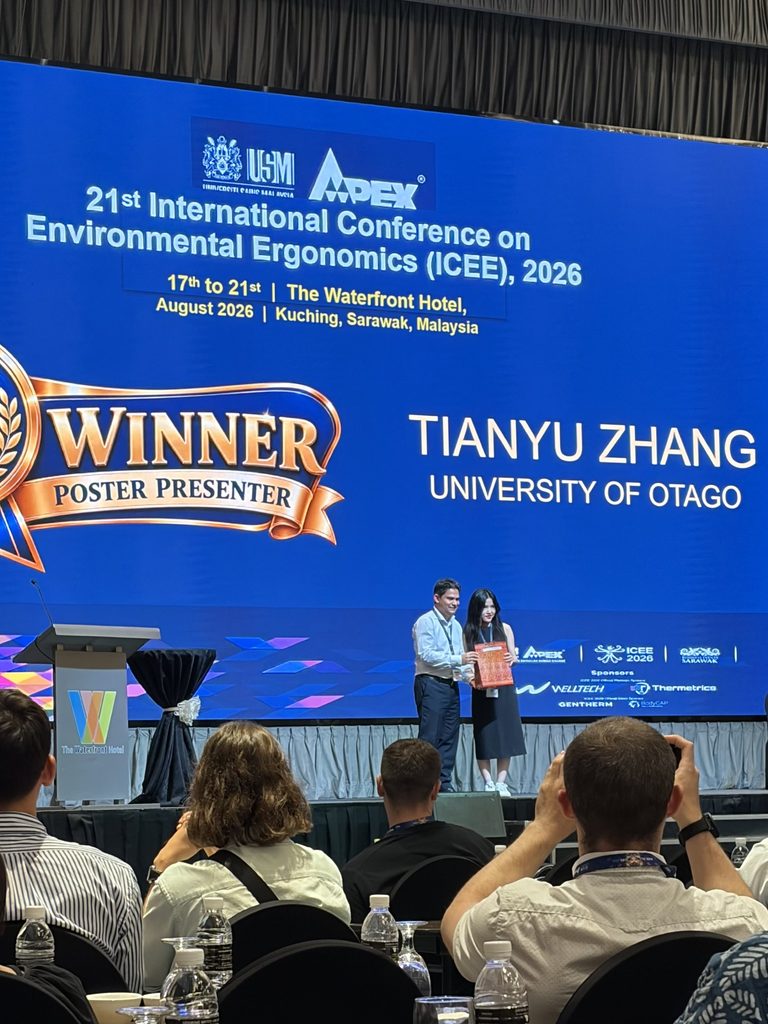
There is something incredibly rewarding about seeing a student develop an interest in a research area during their undergraduate degree and then take that interest with them, building their own expertise and carving out their own path within the field. I feel incredibly grateful to have played even a small part in sparking that initial interest. But, more than anything, I felt humbled. Watching her present her work with such confidence, enthusiasm and engagement was a wonderful reminder that the impact of academic mentoring isn’t always something you see immediately. Sometimes it takes years before you get to see where that first spark of curiosity leads. Seeing her at ICEE, on the other side of the world and now contributing her own research to the international environmental physiology community, was a genuinely proud moment. And winning first place made it even better!
For me, these connections are a really encouraging sign.
The Female Heat Laboratory is part of a much wider and rapidly developing international community asking better questions about how humans respond to heat — and increasingly, asking who has been missing from the evidence along the way.
Beyond the Science
Of course, ICEE wasn’t all presentations and scientific discussion! The social programme was a brilliant opportunity to experience a little of Sarawak alongside colleagues from around the world.
From shared meals and conversations that continued long after the scientific sessions had finished, to the unforgettable opportunity to see orangutans, the social events were a real highlight of the conference. These informal moments are often where some of the best conversations happen — and they certainly added something special to an already memorable ICEE.
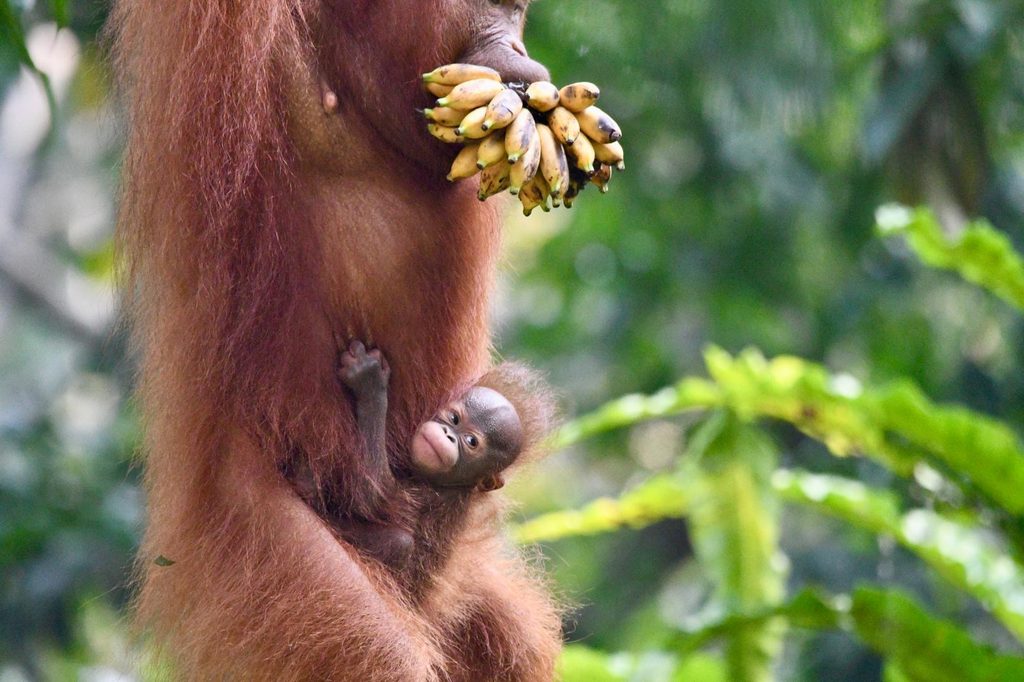
It was a wonderful reminder that conferences like ICEE are about much more than sharing research. They are about building friendships, collaborations and an international community around the science.
What’s next?
I came away from ICEE feeling both hugely encouraged and very aware of how much work there is still to do. There is clearly growing interest in understanding women’s responses to heat across the lifespan. There is also an increasing recognition that sex-inclusive research needs to be more than an aspiration — it needs to be reflected in how studies are designed, conducted and reported. That will require collaboration across disciplines, countries and career stages. And it will require us to be honest about what we know, what we don’t know, and where the barriers to better research actually lie.
Thank you to Professor Toby Mündel for bringing together such a thoughtful symposium, to Hannah and Nicole for sharing their work, and to everyone at ICEE who contributed to the conversations afterwards.
It was a privilege to be part of the first ICEE in Malaysia — and even more exciting to see the conversation around women, heat and environmental physiology continuing to grow.
The future of heat physiology needs women in the research — and it needs researchers willing to ask how we can do that research better.